 Add to Chrome
 Add to Firefox
 Add to Edge
PhyWorld: Physics-Faithful World Model for Video Generation
May 19, 2026
World simulators can provide safe and scalable environments for training Physical AI systems before real-world deployment. Large video generation models are emerging as a promising basis for such simulators because they can generate diverse and realistic visual futures. However, using them as world simulators requires physically faithful video continuations, namely, generated videos that preserve the physical state implied by the conditioning input, and evolve in ways consistent with basic physical principles. We propose PhyWorld, a video generation world model designed to produce temporally coherent and physically faithful scene continuations through two-stage post-training. In the first stage, we improve video-to-video continuation with flow matching fine-tuning, encouraging stable visual attributes and coherent motion dynamics across frames. In the second stage, we align generated dynamics with physical principles using Direct Preference Optimization (DPO) over physics preference pairs, guiding the model toward outputs with higher physical plausibility. To evaluate PhyWorld, we use both standard video-quality benchmarks and a dedicated physical-faithfulness benchmark with per-law scoring. Experiments show that PhyWorld improves video consistency, achieving an average score of 0.769 on VBench compared with 0.756 or below for state-of-the-art baselines. PhyWorld also improves physical plausibility, reaching an average score of 3.09 on our physical-faithfulness benchmark compared with 2.99 for the strongest baseline. These results suggest that post-training large video generation models with continuation and physics-preference signals can make them more effective world simulators for Physical AI.

PhyGround: Benchmarking Physical Reasoning in Generative World Models
May 11, 2026Generative world models are increasingly used for video generation, where learned simulators are expected to capture the physical rules that govern real-world dynamics. However, evaluating whether generated videos actually follow these rules remains challenging. Existing physics-focused video benchmarks have made important progress, but they still face three key challenges, including the coarse evaluation frameworks that hide law-specific failures, response biases and fatigue that undermine the validity of annotation judgments, and automated evaluators that are insufficiently physics-aware or difficult to audit. To address those challenges, we introduce PhyGround, a criteria-grounded benchmark for evaluating physical reasoning in video generation. The benchmark contains 250 curated prompts, each augmented with an expected physical outcome, and a taxonomy of 13 physical laws across solid-body mechanics, fluid dynamics, and optics. Each law is operationalized through observable sub-questions to enable per-law diagnostics. We evaluate eight modern video generation models through a large-scale, quality-controlled human study, grounded on social science lab experiment design. A total of 459 annotators provided 5,796 complete annotations and over 37.4K fine-grained labels; after quality control, the retained annotations exhibited high split-half model-ranking correlations (Spearman's rho > 0.90). To support reproducible automated evaluation, we release PhyJudge-9B, an open physics-specialized VLM judge. PhyJudge-9B achieves substantially lower aggregate relative bias than Gemini-3.1-Pro (3.3% vs. 16.6%). We release prompts, human annotations, model checkpoints, and evaluation code on the project page https://phyground.github.io/.
A Very Big Video Reasoning Suite
Feb 24, 2026Rapid progress in video models has largely focused on visual quality, leaving their reasoning capabilities underexplored. Video reasoning grounds intelligence in spatiotemporally consistent visual environments that go beyond what text can naturally capture, enabling intuitive reasoning over spatiotemporal structure such as continuity, interaction, and causality. However, systematically studying video reasoning and its scaling behavior is hindered by the lack of large-scale training data. To address this gap, we introduce the Very Big Video Reasoning (VBVR) Dataset, an unprecedentedly large-scale resource spanning 200 curated reasoning tasks following a principled taxonomy and over one million video clips, approximately three orders of magnitude larger than existing datasets. We further present VBVR-Bench, a verifiable evaluation framework that moves beyond model-based judging by incorporating rule-based, human-aligned scorers, enabling reproducible and interpretable diagnosis of video reasoning capabilities. Leveraging the VBVR suite, we conduct one of the first large-scale scaling studies of video reasoning and observe early signs of emergent generalization to unseen reasoning tasks. Together, VBVR lays a foundation for the next stage of research in generalizable video reasoning. The data, benchmark toolkit, and models are publicly available at https://video-reason.com/ .
ALTER: All-in-One Layer Pruning and Temporal Expert Routing for Efficient Diffusion Generation
May 27, 2025Diffusion models have demonstrated exceptional capabilities in generating high-fidelity images. However, their iterative denoising process results in significant computational overhead during inference, limiting their practical deployment in resource-constrained environments. Existing acceleration methods often adopt uniform strategies that fail to capture the temporal variations during diffusion generation, while the commonly adopted sequential pruning-then-fine-tuning strategy suffers from sub-optimality due to the misalignment between pruning decisions made on pretrained weights and the model's final parameters. To address these limitations, we introduce ALTER: All-in-One Layer Pruning and Temporal Expert Routing, a unified framework that transforms diffusion models into a mixture of efficient temporal experts. ALTER achieves a single-stage optimization that unifies layer pruning, expert routing, and model fine-tuning by employing a trainable hypernetwork, which dynamically generates layer pruning decisions and manages timestep routing to specialized, pruned expert sub-networks throughout the ongoing fine-tuning of the UNet. This unified co-optimization strategy enables significant efficiency gains while preserving high generative quality. Specifically, ALTER achieves same-level visual fidelity to the original 50-step Stable Diffusion v2.1 model while utilizing only 25.9% of its total MACs with just 20 inference steps and delivering a 3.64x speedup through 35% sparsity.
Open-Source Acceleration of Stable-Diffusion.cpp
Dec 08, 2024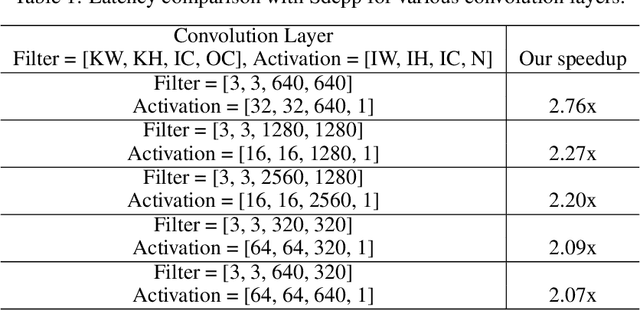
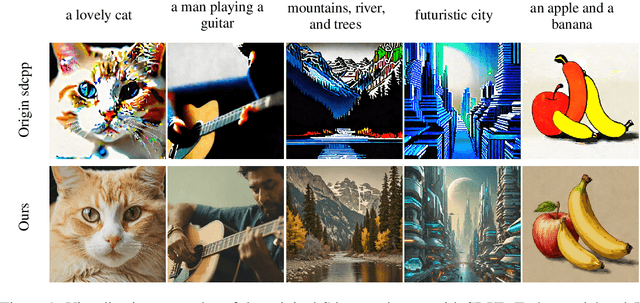
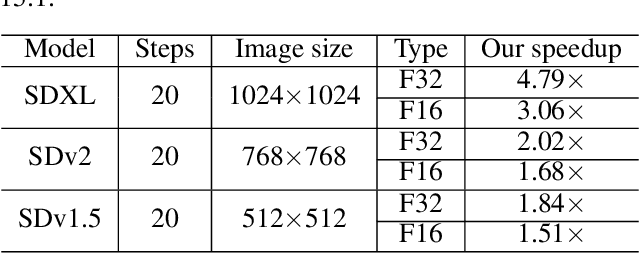

Stable diffusion plays a crucial role in generating high-quality images. However, image generation is time-consuming and memory-intensive. To address this, stable-diffusion.cpp (Sdcpp) emerges as an efficient inference framework to accelerate the diffusion models. Although it is lightweight, the current implementation of ggml_conv_2d operator in Sdcpp is suboptimal, exhibiting both high inference latency and massive memory usage. To address this, in this work, we present an optimized version of Sdcpp leveraging the Winograd algorithm to accelerate 2D convolution operations, which is the primary bottleneck in the pipeline. By analyzing both dependent and independent computation graphs, we exploit the device's locality and parallelism to achieve substantial performance improvements. Our framework delivers correct end-to-end results across various stable diffusion models, including SDv1.4, v1.5, v2.1, SDXL, and SDXL-Turbo. Our evaluation results demonstrate a speedup up to 2.76x for individual convolutional layers and an inference speedup up to 4.79x for the overall image generation process, compared with the original Sdcpp. Homepage: https://github.com/SealAILab/stable-diffusion-cpp